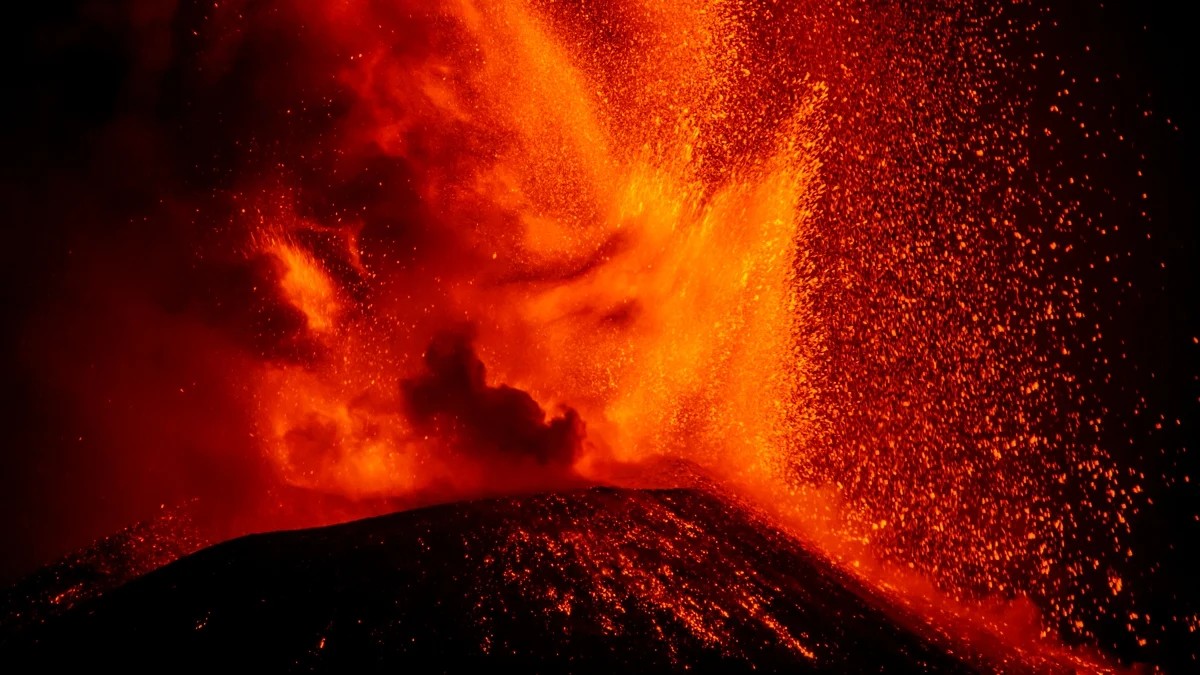
For over half a million years, Mount Etna has dominated the Sicilian skyline. Standing at 3,400 meters, this massive stratovolcano is not just a landmark; it is Europe’s most active volcanic powerhouse, frequently erupting several times a year. Yet, despite centuries of observation and modern high-tech monitoring, Etna has long remained a geological anomaly.
A recent study has finally begun to pull back the curtain on this mystery, suggesting that Etna operates via a rare mechanism previously thought to exist only in much smaller, submarine environments.
The Scientific Paradox
To understand why Etna is so unusual, one must look at the chemistry of its eruptions. Most stratovolcanoes produce specific types of lava based on their tectonic setting. Etna, however, is famous for its alkaline lava.
In volcanology, there is a fundamental “speed limit” regarding this type of magma. Alkaline lava requires a very low degree of partial melting in the mantle to preserve its chemical signature. Because this process is slow and delicate, it typically cannot produce the massive, frequent volumes of lava that Etna churns out. This created a long-standing contradiction: How can a volcano so large and so frequent produce lava that should, by all laws of geology, take much longer to form?
Breaking the Rules of Tectonics
Most volcanoes on Earth fall into one of three predictable categories:
1. Divergent Boundaries: Plates pull apart, allowing mantle material to rise (common in oceanic ridges).
2. Subduction Zones: One plate slides beneath another, carrying water that lowers the melting point of the mantle (often resulting in violent eruptions).
3. Hotspots: A plume of superheated material rises through the middle of a plate (creating shield volcanoes like Hawaii).
Etna sits in a complex position. It is a stratovolcano located above a subduction zone (where the African Plate meets the Eurasian Plate), yet its lava chemistry looks like it belongs to a hotspot. However, there is no known hotspot beneath Sicily to explain this.
A “Sponge” in the Mantle
By analyzing the chemical profile of Etna’s lava over the last 500,000 years, researchers discovered something startling: the lava’s composition has remained remarkably consistent, even as the surrounding tectonic plates have shifted.
This consistency suggests that Etna is not tapping into “fresh” magma created by immediate tectonic movement. Instead, it appears to be drawing from a pre-existing reservoir of magma trapped deep within the Earth—roughly 80 kilometers below the surface, in the low-velocity zone between the upper mantle and the base of the tectonic plates.
The researchers propose a new model for Etna’s behavior:
– The volcano acts similarly to a “petit-spot” volcano.
– These are rare structures where magma is squeezed out of pockets in the upper mantle.
– As the African Plate subducts, it essentially “squeezes” this trapped alkaline magma through cracks in the crust, much like water being squeezed from a sponge.
Why This Matters
While the discovery explains the “how,” it also highlights the unique scale of Etna. Petit-spot volcanoes are typically tiny, submarine structures rising only a few hundred meters. Etna, by contrast, is a colossal mountain. This suggests that Etna may be a unique geological phenomenon —a massive scale version of a process previously only seen in small, underwater vents.
Beyond the scientific curiosity, this research is vital for public safety. Mount Etna looms dangerously close to the major Sicilian cities of Catania and Messina. Understanding the specific mechanism that feeds the volcano allows scientists to better predict its behavior and assess the hazards posed to the hundreds of thousands of people living in its shadow.
“Our study suggests that Etna may have formed through a mechanism similar to the one that generates petit-spot submarine volcanoes,” notes lead author Sébastien Pilet. “This is unexpected, as such processes had previously only been observed in very small volcanic structures.”
Conclusion: Mount Etna appears to be a rare geological hybrid, utilizing a “petit-spot” mechanism to tap into deep, ancient magma reservoirs. This discovery redefines our understanding of how large-scale volcanoes can function and provides critical context for monitoring one of the world’s most volatile landscapes.