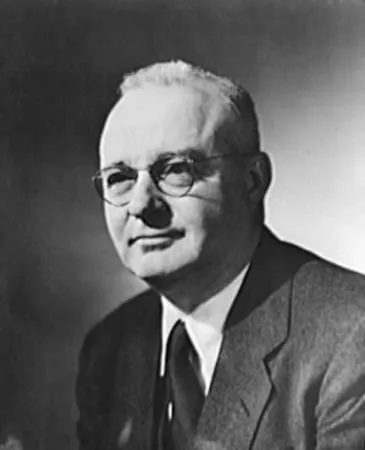
Thomas Midgley Jr. didn’t just make a mistake. He made two discoveries that reshaped the modern world, and both were catastrophic in ways he either ignored or failed to foresee.
He is the only person in history to be elected to the National Academy of Sciences while simultaneously holding the distinction of being one of history’s most harmful inventors. His legacy is a stark warning about the gap between technical success and real-world consequence.
How Tetraethyl Lead Solved Engine Knock
The problem was simple. Cars were getting faster. Engines were getting more powerful. But they were also knocking.
Engine knock is that rattling sound that happens when fuel burns unevenly inside a cylinder. It damages the engine. It limits performance. By 1916, as compression ratios increased, knock became a major barrier to automotive progress.
Midgley, an engineer at General Motors, was tasked with fixing it. He started by looking at ignition systems. He quickly realized the spark plugs weren’t the issue. The fuel mixture was.
He stumbled upon ethyl iodide. It worked. It stopped the knock. But it was expensive and corrosive. He needed something better. Something cheap. Something scalable.
He turned to the periodic table. He tested element by element. The goal was tetraethyl lead as an antiknock additive for gasoline.
In 1921, his team found a solution. Tiny amounts of tetraethyl lead eliminated knock entirely. The engines ran smoother. They ran faster. The public loved it.
There was a catch. The lead left deposits in the engine. These deposits clogged valves and ruined cylinders. Midgley needed a way to remove the lead.
He found a partner in ethylene bromide. When mixed with the lead, the bromide reacted with it during combustion. The lead was expelled through the exhaust pipe. Clean engine. Dirty air.
To get the bromide, he needed bromine. It was rare. He developed a method to extract it from seawater. It was cheap. It was abundant.
Why the Health Risks Were Ignored
Lead poisoning is not new. The Romans knew it. Factory workers in the 1920s knew it.
Midgley knew it too. In fact, he suffered from it.
He handled the raw chemicals directly. He inhaled fumes. He got sick. He had to step away from the lab to recover.
Most people would have stopped. Midgley didn’t. He remained convinced that the risks were manageable. He believed that the trace amounts of lead particulates in the exhaust would not harm the public.
He was wrong.
As vice president of the Ethyl Gasoline Corporation, he sold the idea to a skeptical public. He argued that the benefits of cleaner-running engines outweighed the theoretical risks. The theory was flawed. The reality was a slow-moving environmental disaster.
The Refrigerant That Cooled Houses and Wounded the Sky
Midgley’s second major discovery came in 1930.
Refrigerants were dangerous. Ammonia leaked and killed people. Chlorine and methyl chloride were flammable. A house fire caused by a fridge was a real fear.
Midgley was asked to find something safe. Odorless. Non-toxic. Non-flammable.
He had three days.
He settled on dichlorodifluoromethane. It was called Freon-12. It was perfect for the job. It didn’t explode. It didn’t smell. It worked.
It was also a chlorofluorocarbon, or CFC.
Decades later, we would learn that CFCs rise into the stratosphere. There, UV radiation breaks them apart. The chlorine atoms they release eat away at the ozone layer. The protective shield of the Earth weakens. UV radiation increases. Skin cancer rates climb.
Midgley never saw this. He died in 1944. But the chemical he chose remained in the atmosphere for decades, causing damage long after he was gone.
A Life Invented to Escape Gravity
Midgley was not a villain in a cartoon. He was a brilliant engineer. A problem solver.
He held patents for 98 inventions. He helped develop the electric starter. He worked on synthetic rubber during World War II. He was a director at the Ohio State University Research Foundation. He received four medals from the American Chemical Society.
Then came polio.
In 1940, he contracted the disease. He lost the use of his legs.
He did not stop working. He designed a system of ropes and pulleys to lift himself in and out of bed. It was a marvel of engineering. It allowed him to maintain his routine. It allowed him to continue his research.
On November 2, 1944, he got tangled in the ropes.
The mechanism he built to give him freedom took his life by strangulation.
Midgley’s story is not just about bad luck. It is about a mind that saw solutions where others saw problems, but failed to see the second-order effects. He saved engines. He cooled homes. He accelerated pollution.
We still burn leaded gasoline, in a sense. We still use synthetic compounds that linger in the ecosystem. We still trust engineers who prioritize function over foresight.
The question isn’t whether Midgley was smart. He was. The question is why we keep looking for easy fixes when the answers usually come with a price we haven’t calculated yet.