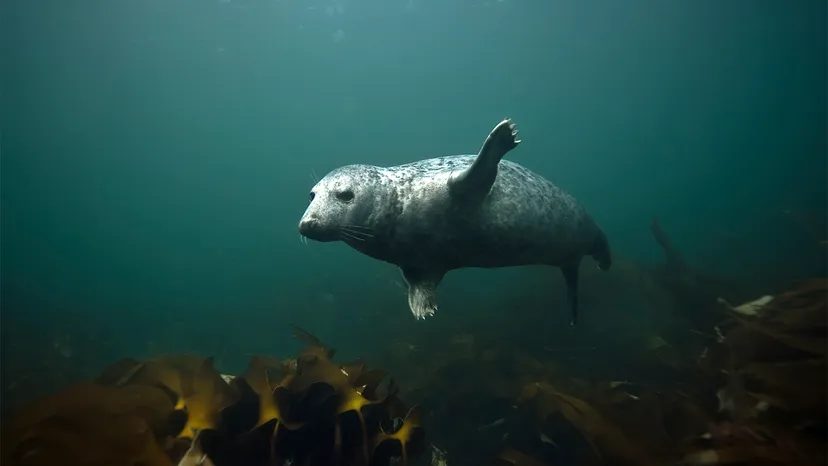
We have spent years meme-ing the seal clap of seals. It’s an iconic image. A seal on land happily waves its flippers together at the clap. The gesture is so clear that actress Nicole Kidman’s awkward applause at the 2017 Oscars was immediately dubbed “seal hands.” We thought we knew all about this behavior. We thought it was just a quirk happening on land.
We were wrong.
Research conducted by Monash University in Australia has fundamentally changed our understanding of marine mammal communication. A study published in the journal Marine Mammal Science in January 2020 shows that seals don’t only clap on land. They also do it underwater. This is the first observation of a seal in the wild using “percussive signaling” below the surface.
Capturing the invisible
The footage is hard to believe because it is incredibly difficult to record. Naturalist Dr. Ben Burville, visiting researcher at Newcastle University in the United Kingdom, spent 17 years diving off the Farne Islands in North East England. He was looking for this moment. Most divers would miss it.
Each clap takes less than a second. You look away and it’s gone.
Burville eventually caught a male gray seal swimming near a female. As he swished past her, the male quickly smacked his forelimbs together, one at a time. Each hit produced a sharp, gunshot-like sound. The event was short. It happened quickly. But it was true.
A social signal, not just noise
Why clap underwater? The context suggests that there is more to it than just noise. A male seal was swimming near a female who was making guttural noises. Researchers speculate that this clapping plays an important role in social interactions, especially in reproduction.
The video supports this theory. The female swam away. She returns later. The male claps once more. Then he gets frisky, nearly biting her. This series of events lends weight to the idea that sound acts as a form of social bonding or courtship.
Mating and competition
It appears that only male seals exhibit this type of clapping behavior underwater. They usually target other seals. The authors suspect that this is mating behavior. It serves two purposes. First, it drives away potential competitors. Second, it advertises the male’s fitness to females.
The sound itself is impressive. It is described as a sharp, percussive crack. We don’t know if other seal breeds make the same sound. Similar acoustic signals exist elsewhere in the marine mammal spectrum. Harbor seals slap their pectoral flippers. Humpback whales do similar things with fins. But the underwater clapping of the gray seal is unique in its documentation.
Underwater songs
Seals aren’t the only marine animals that use sound to communicate. During the breeding season, leopard seals also sing in the depths. We’re not entirely sure why they produce these vocal surprises. The exact function remains a mystery.
But the message is clear. The sea is louder and more complex than we thought. Seals use sound in ways we are only beginning to understand. The gap between what we see on land and what happens under the waves is bigger than we thought. And there is still much to discover.