We are missing stuff. Lots of it.
Cosmologists have known this for years. The math says there should be more ordinary matter out there. The kind that makes stars. Planets. You. But when we look at galaxies, the numbers don’t add up. We only see about one-tenth of what the Big Bang model predicts.
For decades, the assumption was simple. The rest of the matter? It’s hiding. Probably floating in the empty voids between galaxies. Thinly spread. Invisible. Almost undetectable.
Until now.
A new study flips the script on missing galactic matter locations. Researchers from MIT and the CHIME/FRB collaboration have finally found it. And it turns out the journey there was violent.
How fast radio bursts map invisible matter
The trick wasn’t better telescopes. It was better noise.
The team used Fast Radio Bursts (FRBs). Discovered in 2007. These are millisecond flashes of radio waves. Incredibly bright. They come from billions of light-years away. As they travel to Earth, they pass through intergalactic gas. The matter smears the signal. Stretches it out in time.
Think of it like a cosmic X-ray.
“They start out as a very quick flash,” explains Haochen Wang, a graduate researcher at MIT’s Kavli Institute. “As they pass through matter, they smear out. We measure that smearing precisely.”
The smearing is directly proportional to the amount of matter in the way. More smearing means more mass.
To pin down exactly where that matter lives, the team combined data from two massive sources. The Canadian Hydrogen Intensity Mapping Experiment. The Dark Energy Spectroscopic Instrument. They cross-correlated thousands of FRB signals with millions of galaxy positions.
Did the signal get smeared inside a galaxy? Or between them?
The answer changed everything.
Why black holes are more violent than we thought
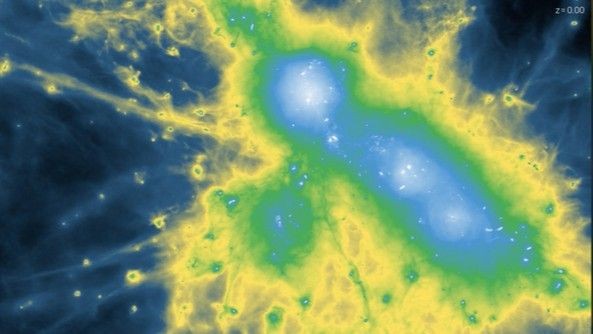
The missing matter is indeed between galaxies. But not where we expected.
Simulations predicted the gas would sit relatively close. A few hundred thousand light-years from a galaxy’s center. Maybe up to a million.
The new data shows clouds extending out to 4 million light-years.
That is far. Very far.
If you kick a ball gently, it rolls. If you kick it into orbit, you need serious force. This matter wasn’t just pushed. It was hurled.
Kiyoshi Masui, an MIT physics professor, put it bluntly. Star activity and black hole jets are “much more violent than predicted.”
The implications are sharp.
- Black hole jets punch harder.
- Supernova explosions throw material farther.
- Galaxies bleed matter into space at a rate that defies current simulations.
The universe is more energetic than our models allow.
Which method finally solves the ordinary matter mystery
This isn’t just about finding missing pieces. It’s about the method.
Using FRBs as probes for missing galactic matter is the breakthrough. Before this, the gas was too thin to spot. Now, the smearing effect provides a clear metric.
The results, published in Physical Review Letters, confirm two things.
- The ordinary matter exists. It’s not gone. It’s just displaced.
- The mechanisms displacing it are stronger than physics currently accounts for.
Seventeen percent of the universe should be ordinary matter. We’ve only accounted for a fraction of that within galaxy borders. The rest is out there. In the deep dark. Swept away by forces we are only now beginning to measure.
CHIME is still collecting data. More FRBs are being found. The map is getting clearer.
But the question remains. If galaxies are leaking this much energy and matter, what does that do to the structure of the cosmic web?
We might need to rewrite the rules of galactic evolution. Again.