It didn’t just flash. It lasted.
Scientists caught a radio signal from the sun that refused to quit. It pulsed for nearly three weeks. That shattered every record on the books. Most “type IV” radio bursts flare and vanish in hours. This one stuck around for about 19 days. Almost four times the previous champion.
Eerie is the right word.
NASA and European Space Agency ships were in position last August. Solar Orbiter saw it first. Then, nearly two weeks later, Parker Solar Probe and Wind near Earth caught the same tune. STEREO-A joined in a day after that. It wasn’t a string of random explosions. The source was rotating with the sun. One long-lived event.
The pattern hinted at a single, enduring structure rather than chaos.
The signal had a rhythm. Every 45 minutes or so, it would brighten. Then dim. Like a heartbeat. Or a ringing bell.
Magnetic structures high above the photosphere probably vibrated. These vibrations squeezed the trapped electrons in a cycle. The squeeze changed the radio brightness. Simple physics. Messy results.
This implies the sun can hold onto huge reservoirs of energetic particles for weeks. We used to think these reservoirs were short-lived. They weren’t.
Why does that matter? Solar storms don’t kill us on the ground. They do wreck satellites, though. GPS fails. Radio goes silent. Power grids blink out.
Understanding these sources helps us forecast space weather. The new trick? You might only need one spacecraft to triangulate the source. Before this, you needed more data points to pin things down.
Mashable Light Speed
Want more out-of-this-world tech? Sign up for our newsletter.
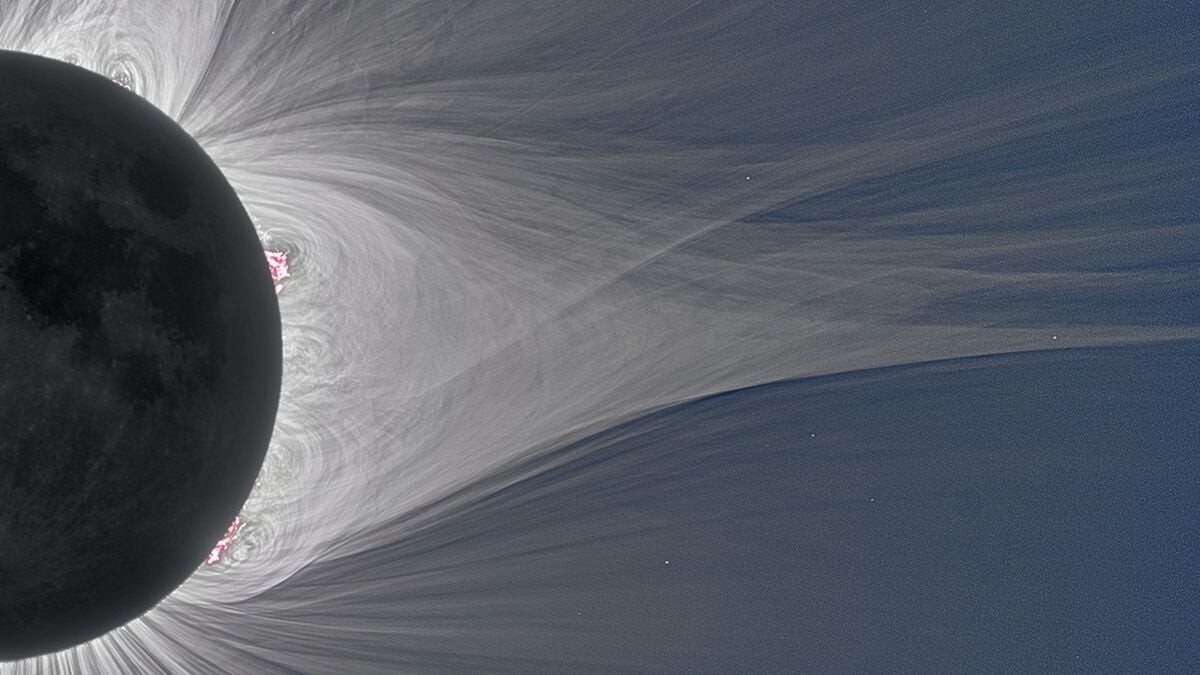
The source likely sat near a helmet streamer. Imagine a giant arch of magnetic field rising from the atmosphere into the dark. This one was more than 1.2 million meters wide. Massive, even for solar standards.
Three fast coronal mass ejections (CMEs) coincided with the burst. These are blobs of plasma and magnetism blasted into the void. The researchers think these CMEs fed fresh electrons into the trap. They kept the party alive.
NASA’s STEREO-A tracked it from Sept 6 to Sept 9, mapping the emissions across the rotation. Credit: Vratislav Krupar et all 2026
The radio waves showed strong polarization. Oscillations were orderly, not chaotic. That suggests the electrons weren’t bouncing randomly. They moved through a structured magnetic environment.
No one knows the exact mechanism yet.
One theory involves plasma emission. Energetic electrons move through thin gas and naturally create noise. Standard stuff. The other idea is weirder. A natural microwave laser operating in a low-density cavity. Rarer.
The evidence points to a giant rotating magnetic trap. It survived for weeks while eruptions fed it fuel.
There’s also a technical fix here. Low-frequency radio waves bend as they travel through space. This makes the source hard to find. The team developed a correction for that distortion. They traced the noise to heights of 2.5 to 4 million miles above the sun.
Future missions should use this method. Better imaging. Better particle tracking. We will likely see clearer eruptions coming our way.
For now, we just watch the data stream in. The sun keeps its secrets well, but it leaves footprints. We just need better shoes to follow them.