Space travel isn’t static. Destinations move. That complicates things.
Isaac Rudich and Michael Römer solved this. Or at least a version of it.
Our research is foundational.
That’s the takeaway. From Polytechnique Montréal and Universität Bielefeld, respectively, the pair built math that agencies can use. Not today. Maybe later. But useful.
The moving target issue
Consider the Traveling Salesperson problem. Classic stuff. You map the shortest route between towns, visit them all, go home. Easy enough.
If the towns are sitting still.
Asteroids aren’t towns. They fly around. Constantly.
Voyager 1 and 2 used planetary gravity to slingshot past planets. That helps. It gives you free rides.
But hopping between asteroids? That burns fuel. No free gravity here. Just brute force propulsion and changing distances.
The gap between rocks shrinks then grows. Timing becomes everything.
Entering the ARP
The duo renamed the challenge. Asteroid Routing Problem. ARP for short.
The question is specific: in what order do we visit these rocks to minimize both time and gas?
It’s not just about the order. You have to know when to leave. The trajectory shifts based on departure time.
Then there is Lambert’s problem.
Named after Johann Heinrich Lambert. A Swiss polymath from the 1700s. He asked how to fly between two moving objects. Joseph-Louis Lagrange solved it later that same century. Yes. The Lagrange from the Lagrange points.
Solving Lambert for two bodies is manageable. Add five bodies? The math explodes. You calculate every possible route for every possible pair. Computational suicide.
Making sense of the mess
To avoid burning through servers, they used Decision Diagrams.
Think of a Decision Tree but compressed. A graph where paths start from a root. Usually, different choices lead to different branches. In these diagrams, choices leading to the same place and time merge.
One node replaces many.
It simplifies the map. Lambert’s problem doesn’t need solving as often.
Our approach typically achieves solutions about 20% better.
Twenty percent less fuel and time. Combined. For bigger problems, the gains might be even larger.
Real world or stylized?
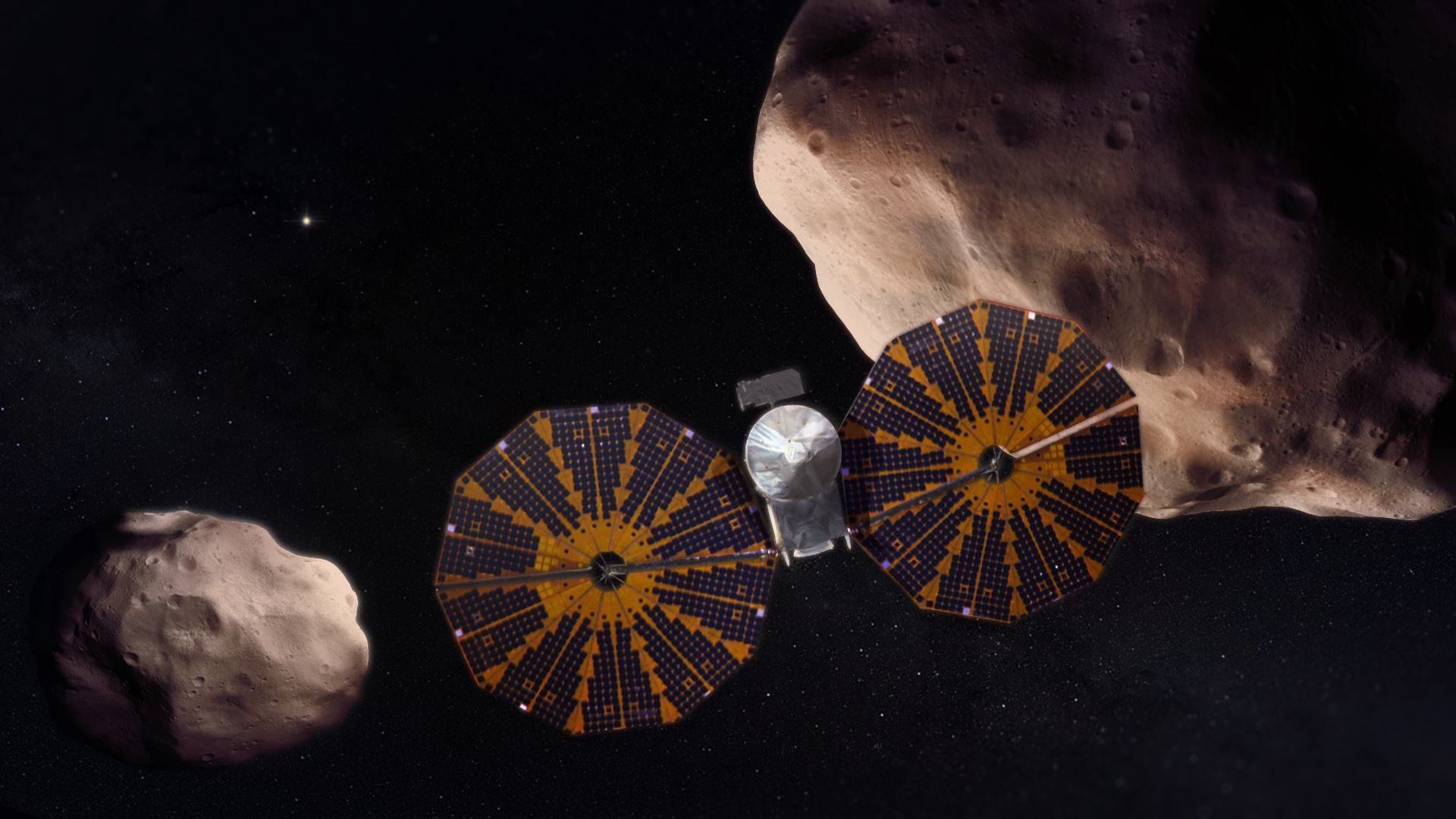
Few missions do this. NASA’s Dawn went to Vesta then Ceres. Lucy is heading toward Jupiter’s Trojans via the main belt.
Lucy will pass close to several rocks. Then five specific ones.
Could their method have helped plan Lucy?
“It would certainly be interesting.”
But don’t expect an exact match yet. The ARP model is clean. Almost too clean. Real astrodynamics is messy. Weather on Earth ruins bus schedules; moving asteroids ruin spacecraft schedules.
To model a real mission perfectly? You need more variables.
Still.
Even a 1% savings matters. In space, every gram counts. Every minute costs.
This math could fix supply chains too. Or bus routes where traffic shifts unpredictably. The variables change. The destinations stay put. But the logic? It holds.
The rockets are waiting. The math is ready. We just need to look up. 🚀