A striking natural phenomenon recently unfolded in southwest Quebec, where a lake known for its resemblance to a shocked emoji face completely drained into the surrounding landscape. The event, described by experts as a rare outburst flood, highlights the fragility of post-glacial environments when subjected to modern environmental stressors.
A Shocking Transformation
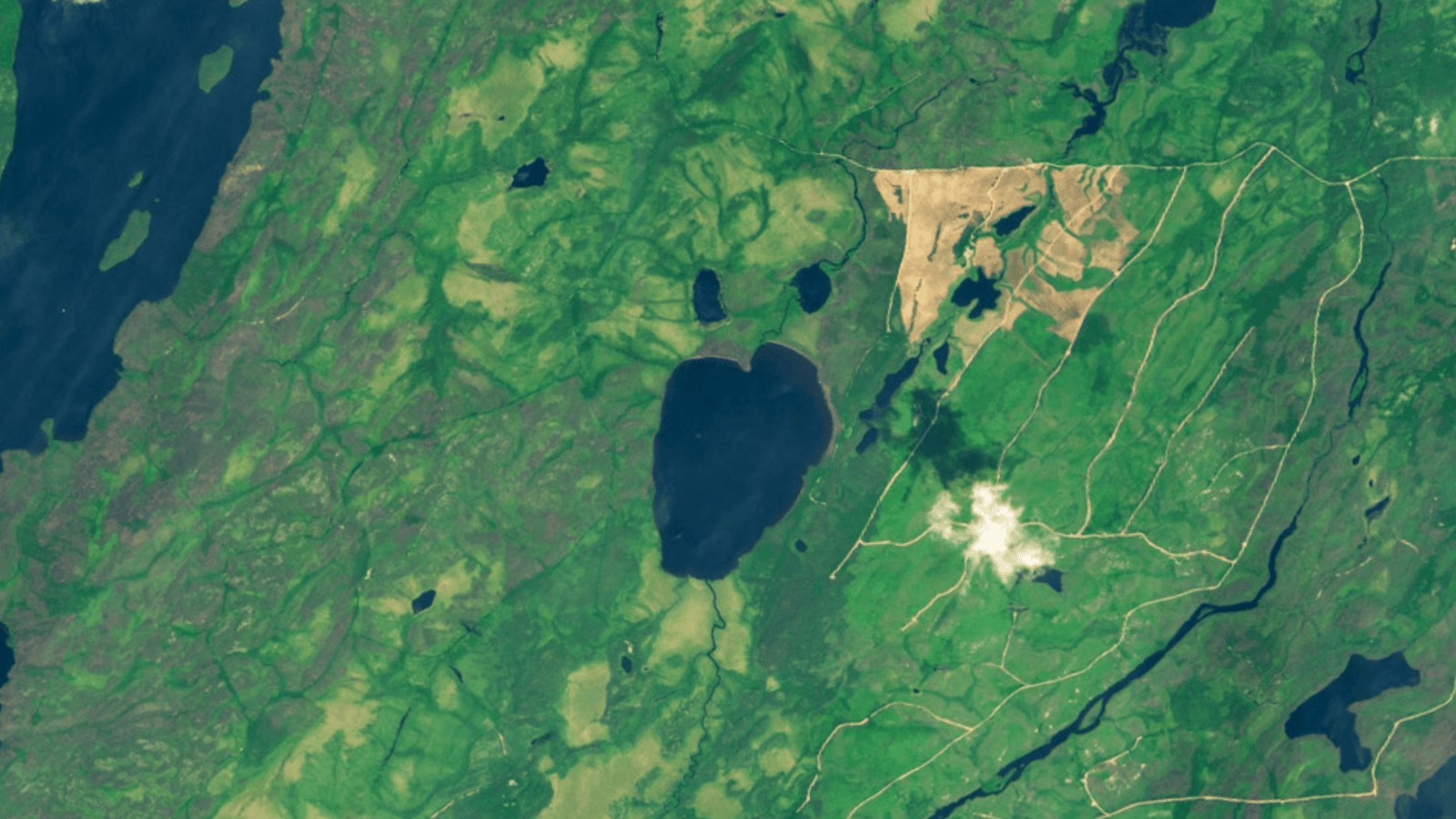
Lake Rouge (Lac Rouge) was approximately one square mile (3 square kilometers) in size. Situated between two smaller, unnamed lakes, the trio formed a distinctive shape from above: the smaller lakes acted as “eyes,” while Lake Rouge served as a wide-open “mouth.” This unique geography earned it the nickname “emoji lake” among satellite observers.
In May 2025, members of the Cree First Nation of Waswanipi, who rely on the area for hunting, fishing, and trapping, discovered that the lake had vanished. Instead of water, they found a thick layer of mud and dead fish coating a nearby logging road. Tracing the debris back to its source, they identified that the eastern bank of Lake Rouge had collapsed in a landslide-like event.
This collapse triggered a violent torrent known as an outburst flood. While the two smaller “eye” lakes remained intact, Lake Rouge’s entire water supply spilled outward. Satellite imagery reveals that the sediment-laden water traveled roughly 6 miles (10 kilometers), punching through smaller ponds before finally emptying into the much larger Doda Lake.
“It looks like a natural disaster,” said Irene Neeposh, Chief of Waswanipi. “We’ve never seen anything like this.”
The Aftermath: A Muddy Legacy
The impact of the flood extended far beyond the immediate vicinity of Lake Rouge. The surge of water and sediment transformed Doda Lake—a body of water spanning roughly 29 square miles (75 square km)—into a massive, muddy expanse. Interestingly, the adjacent Father Lake (also known as Priest Lake) remained unaffected, despite its proximity to the polluted waterway.
Researchers determined that the collapse occurred between April 29 and May 14, 2025, based on satellite data comparisons. The timing underscores the suddenness of the event; what was once a stable freshwater body became a dry, muddy basin in a matter of days.
Why Did It Happen?
Outburst floods are typically associated with glacial lakes or human-made reservoirs, where ice or concrete structures can fail catastrophically. The collapse of a natural earthen bank in a non-glacial setting is extremely rare. Experts initially attributed the failure to heavy snowfall that winter, which raised water levels significantly. However, further analysis revealed a complex interplay of factors:
- Wildfire Impact: The region suffered severe wildfires in 2019 and again in 2023—one of Canada’s worst fire years on record. These fires stripped the area of vegetation, destabilizing the topsoil. Without plant roots to hold the earth together, and with scorched soil unable to absorb water effectively, pressure on the lake banks increased dramatically.
- Logging Activities: Decades of logging in the surrounding forests have accelerated snowmelt. Without tree cover to shade the ground and slow the melting process, Lake Rouge filled with water much faster than it would have in a pristine forest, adding weight and pressure to its banks.
- Geological Youth: The landscape of Quebec and much of Canada is geologically young. Covered by massive ice sheets until roughly 20,000 years ago, the terrain is still evolving. François-Nicolas Robinne, a forest hydrologist with the Government of Alberta, noted that this is a “very young landscape that’s evolving very fast.” He suggested that while the collapse might have happened a century from now, the instability was inevitable given the conditions.
A Warning Sign?
This event mirrors other recent geological disruptions in Canada, such as the 2024 landslide in British Columbia’s Chilcotin River, which temporarily trapped endangered salmon. These incidents raise critical questions about the resilience of Canada’s ecosystems in the face of compounding environmental pressures.
The disappearance of Lake Rouge serves as a stark reminder that natural landscapes are not static. When historical factors like post-glacial instability meet modern stressors like climate-driven wildfires and industrial activity, the results can be sudden and dramatic. As researchers continue to study such events, they highlight the need for a deeper understanding of how changing climates interact with fragile geological formations.