


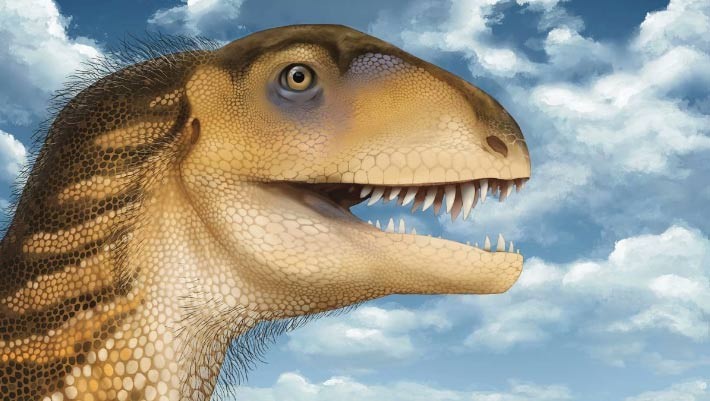
Paleontologists have identified a new species of carnivorous dinosaur in northern New Mexico, a discovery that challenges existing theories about how early dinosaur lineages survived and eventually perished.
The newly named species, Ptychotherates bucculentus , lived approximately 201 million years ago during the Rhaetian stage of the Late Triassic. The discovery provides a rare glimpse into a critical evolutionary period that was previously shrouded in mystery due to a lack of fossil evidence from this era.
A Missing Piece of the Evolutionary Puzzle
For years, the fossil record has presented a geographical gap in our understanding of dinosaur evolution. While most early dinosaur remains have been recovered from the high-latitude southern regions of the supercontinent Pangea—modern-day Brazil, Argentina, Zimbabwe, and India—there has been very little evidence from the lower latitudes, such as the American Southwest or Morocco.
The discovery of Ptychotherates bucculentus helps bridge this gap. Found in the Coelophysis Quarry in New Mexico, the specimen consists of a well-preserved, 22-centimeter skull featuring a complete braincase and a distinct skull roof.
Key Anatomical Features:
- Massive cheekbones
- A wide braincase
- A relatively tall, narrow head with a short, deep snout
These unique physical traits suggest that early dinosaurs were undergoing rapid and constant evolutionary changes, even much earlier than previously documented.
The “Last Stand” of the Herrerasauria
Ptychotherates bucculentus belongs to the Herrerasauria, one of the earliest families of carnivorous dinosaurs. It is closely related to other Triassic species like Tawa hallae and Chindesaurus bryansmalli, forming a newly defined group known as Morphoraptora. This group is characterized by a blend of primitive features and the more advanced traits seen in later theropods.
This find is particularly significant because it alters our understanding of dinosaur survival:
- Unexpected Persistence: Scientists previously believed that by the end of the Triassic, early carnivorous lineages had been entirely replaced by more advanced theropods. Ptychotherates proves that these older lineages actually persisted much longer than once thought.
- Geographic Refugium: The presence of this species suggests that the American Southwest may have served as a final stronghold for these dinosaurs, allowing them to survive in lower latitudes while other lineages vanished elsewhere.
- Impact of Mass Extinction: The fossil was found in rock layers dating to just before the great mass extinction at the end of the Triassic. The fact that no other members of the Herrerasauria are found after this period suggests that this specific group may have been wiped out by the extinction event itself.
“This forces us to reconsider the impact of the end-Triassic extinction as something that wiped out not just the competitors to dinosaurs, but some long-standing dinosaur lineages themselves,” noted paleontologist Simba Srivastava.
Conclusion
The discovery of Ptychotherates bucculentus reveals that early dinosaur lineages were more resilient and geographically diverse than previously understood. It suggests that the end-Triassic mass extinction was a transformative event that cleared the way for new dinosaur groups by eliminating even the most established early lineages.


