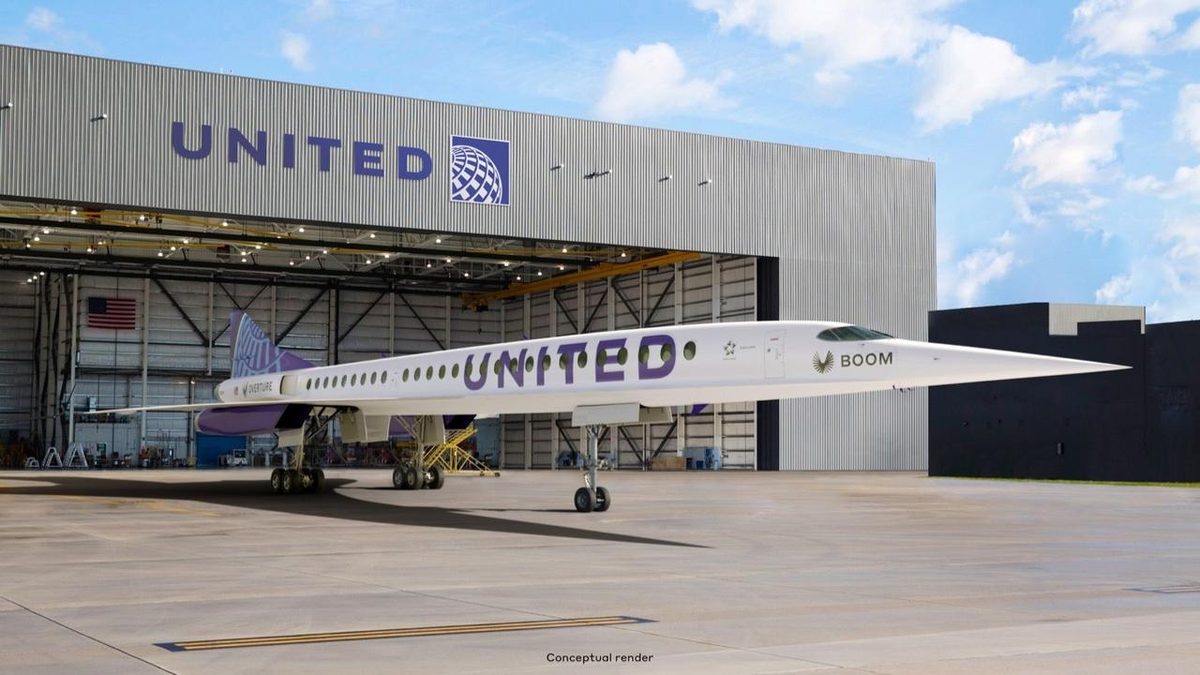
United Airlines has made its move. The carrier signed a deal for 15 supersonic jets from Boom Supersonic. There is an option for 35 more. The price tag remains a secret. This is not just a purchase. It is a bet on the future of flight.
The return of speed
The plane in question is called Overture. Boom Supersonic claims it will be ready by 2025. The first test flight is scheduled for 2026. Passengers might be aboard by 2029. The company wants to replace the Concorde. They unveiled the prototype recently.
The final design is massive. It measures 60 meters long. It carries 44 passengers. That is not a small crew. It is not a luxury jet either. It is a commercial airliner built for speed.
United says Overture flies at Mach 1.7. That is twice as fast as current commercial jets. The airline promises it can reach over 500 destinations. The time savings are the selling point. A flight from Newark to London takes just three and a half hours. Newark to Frankfurt is four hours. San Francisco to Tokyo drops to six hours. These numbers are bold. They are also likely optimistic.
The fuel problem
There is a catch. The jet will use biofuel. The exact composition is unknown. This is a significant hurdle. Biofuel technology is still maturing. Scaling it up for supersonic travel is untested. Can Boom Supersonic deliver on time? The calendar is tight. The engineering is complex. The fuel source is vague.
United is willing to wait. Or at least they are willing to sign the contract while waiting. The industry holds its breath. The skies are quiet. For now.


The Quiet Shift in How We Track Digital Truth
It’s not enough anymore to just know that misinformation exists. The real battle is happening in the metadata, in the invisible layers of code that tell a browser or a social platform whether an image is real or synthetic. This is where AI image detection moves from abstract research to practical enforcement.
Platforms are no longer waiting for users to flag content. They are building internal systems that analyze pixel patterns, compression artifacts, and even the lighting physics within a frame. The goal? To stop deepfakes before they spread, not after they’ve gone viral.
Why Current Detection Methods Are Failing
The arms race between generators and detectors is skewed. Generative models are advancing faster. A model trained to detect today’s AI images might be obsolete by next week. This is why AI content identification can’t rely on static rules. It needs to adapt in real-time.
Think of it like a lock and key. Every time the generator changes the shape of the key, the lock has to be re-cut. But the lock cutter is working with limited resources. The generator has billions of parameters tweaking light and texture. The detector is often working with a fraction of the data.
Where the Real Battle Is Being Fought
Detection isn’t just about the image itself. It’s about the context. A photo might look perfect, but if it was uploaded from a known bot network, the metadata tells a different story. Fake news prevention requires looking at the entire digital footprint.
This includes:
– The origin of the file.
– The timing of the upload.
– The behavior of the account sharing it.
– Cross-referencing with known synthetic datasets.
But here’s the catch. Most consumers don’t see this. They just see a convincing image. That’s why media literacy for digital content is now as important as the technology itself. Users need to know why they should doubt what they see, even if it looks real.
The Human Element in AI Detection
Tech companies are pushing hard for automated solutions. But automation has blind spots. It misses context. It misses intent. A deepfake used for satire is handled differently than one used for political manipulation. Detecting synthetic media isn’t just a technical problem. It’s a legal and ethical one.
We’re seeing a shift toward human-in-the-loop systems. AI flags the content. Humans review the context. It’s slower. It’s expensive. But it’s the only way to get it right.
What’s Next for Content Verification?
The future isn’t about catching every fake. It’s about making fakes less credible. If platforms start labeling uncertain content, the value of a deepfake drops. It becomes noise, not signal. Proving digital authenticity will rely on watermarks, blockchain verification, and trusted sources.
But can we trust the tools we use to verify the truth? That’s the question that keeps researchers up at night.