Rio de Janeiro is currently hosting the Paralympic Summer Games. You are watching disabled athletes compete in dozens of disciplines right now. Some of them are wearing prosthetics. These highly specialized artificial limbs are helping athletes achieve peak performance. Sometimes they even outperform the human original.
This isn’t just about missing a limb. It’s about engineering.
The technology on display here is startling. We aren’t talking about basic hooks or simple peg legs. We are looking at carbon fiber, advanced polymers, and biomechanical designs that mimic the complex anatomy of the human body. But with a twist. These machines are built for one thing: speed. Power. Efficiency.
Beyond the Human Body
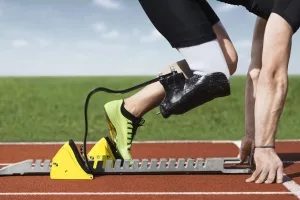
Consider the running blade. It looks like a curved piece of carbon fiber. It has no ankle. No knee. No Achilles tendon. That sounds like a disadvantage until you realize it doesn’t fatigue. It doesn’t cramp. It stores energy like a spring and releases it with minimal loss.
When a sprinter with a prosthetic leg hits the ground, the blade compresses. It stores kinetic energy. Then it snaps back. That release propels the athlete forward with a force that can exceed what a biological joint provides.
It’s not cheating. It’s physics.
But the line between “enhancement” and “disability” gets blurry. We often think of prosthetics as a way to return to normal. Here, they are a way to go beyond it. The athletes aren’t trying to be whole. They are trying to be fast.
The Science of the Blade
Why does this matter? It challenges everything we thought we knew about athletic limits. If a machine can run faster than a human leg, what defines the human athlete?
The answer isn’t simple. The athletes are still human. Their brains still command their bodies. Their hearts still pump. Their training is still grueling. The prosthetic is just an extension. A tool. A partner.
Some critics argue this creates an uneven playing field. They ask if athletes with newer, more expensive blades have an unfair advantage. It’s a valid question. Technology evolves faster than regulations.
But look at the data. The records are falling. Not because the athletes are less capable, but because the tools are more capable. The human spirit is still the engine. The prosthetic is just the transmission.
More Than Just Running
It’s not just about sprinting. Swimmers use hydrodynamic arms. Cyclists use specially designed bikes. Wheelchair racers use lightweight frames that cut through air resistance like a knife.
Every piece of equipment is optimized. Every joint is calculated. Every movement is studied. The result is a sport that is faster, higher, stronger than its able-bodied counterpart in many cases.
This isn’t about pity. It’s about precision.
The athletes in Rio are pushing the boundaries of what’s possible. They are showing us that the body is not a limit. It’s a starting point. And with the right technology, that starting point can be anywhere.
The question isn’t whether the prosthetic is better than a human leg. The question is what happens when we stop viewing disability as a deficit and start viewing it as a different kind of potential.
The blades are still warm from the track. The athletes
Die Biologie ist ein Meisterwerk der Mechanik. Bones meet muscle. Ligaments act like rubber bands. Together they allow us to leap, sprint, and twist in ways that would seem like magic if we weren’t born with them.
We see this machinery at its peak during the Olympics.
Watch the high jumpers clear the bar. Watch the hurdlers fly. Watch divers twist into water with impossible grace. These feats require a body that is intact. Healthy. Prime condition.
But here is the twist.
Sport isn’t just for the whole-bodied. Athletes with amputations are not only participating—they are dominating. And they aren’t doing it despite their prosthetics. They are doing it because of them.
Modern running blades have changed the game entirely.
The Physics of Carbon Fiber Legs
People often ask: how do prosthetic legs work for elite sprinting? They aren’t just hooks or sticks. They are engineering marvels made of carbon fiber.
Think of a spring. When you land, energy is stored. When you push off, that energy is released.
That is exactly what a running blade does.
| Feature | Biological Leg | Carbon Fiber Blade |
|---|---|---|
| Material | Bone, muscle, tendon | Carbon fiber composite |
| Function | Active contraction + passive elasticity | Passive elasticity only |
| Energy Return | ~60-70% efficient | ~93% efficient |
| Weight | High | Extremely low |
The blade stores kinetic energy upon impact. It releases it almost instantly. This “energy return” is higher than a biological tendon. Some studies suggest it can be nearly 93% efficient. Compare that to the human body, which loses significant energy as heat.
Is this unfair?
Debatable. But it is undeniable.
Why Athletes Choose Blades
You might wonder why an athlete would prefer a blade over a natural limb. The answer lies in efficiency and control.
For sprinters like Oscar Pistorius (before his legal troubles) or Tatyana McFadden, the blade offers consistency. Biological muscles fatigue. They get tight. They cramp. A carbon fiber blade does not get tired. It does not get sore.
It just works.
This allows amputee runners to focus on technique rather than pain management. They can push their bodies harder, faster, with less recovery time between sessions.
“It feels like I’m flying. The ground doesn’t just support me; it throws me forward.”
This sentiment is common among blade users. The sensation is not just about speed. It is about a different kind of freedom.
The Evolution of Design
Early prosthetics were rigid. Heavy. Clunky. They looked like medical devices.
Today’s designs look like sports equipment.
They are curved. Aerodynamic. Sculpted.
Companies like Össur and Ottobock invest millions in R&D. They test materials under stress. They analyze ground reaction forces. The goal? To mimic the human gait so closely that the wearer forgets they are wearing a prosthetic.
But they also want to enhance it.
The curve of the blade is not random. It is


Old replacements barely matched the original. Think glass eyes. Wooden peg legs. They were static. Heavy. Broken. Today’s high-tech constructs do not shy away from comparison with the natural counterpart. They compete.
Artificial muscles now drive powerful movements. High precision is standard. Arm and hand prosthetics offer flexible control. Sensors replace at least parts of the sense of touch. The tools move. They grip. They feel. Much like the real thing.
The Material Revolution in Sports
Sports have driven this shift. Specifically, research into modern materials paved the way. Silicone. Plastic. Carbon. These substances opened new doors for athletes with disabilities.
The innovations make prostheses lighter. They are also more durable. Performance has skyrocketed.
“Innovative materials make prostheses lighter, more durable, and higher performing.”
It isn’t just about walking better. It’s about running faster. Jumping higher. Competing on a level field where the gear doesn’t fail you. The athlete becomes the focus. Not the limb.
Why does this matter outside the stadium? Because if a machine can withstand Olympic-level stress, it can handle daily life. A carbon-fiber blade doesn’t break under a stumble. A silicone socket doesn’t chafe after hours. Reliability is built into the molecule.
Which material wins? It depends. Carbon for energy return. Silicone for comfort. Plastic for cost and accessibility. The combination matters most.
The gap between biology and engineering is closing. Slowly. Steadily. But the finish line isn’t in sight.