A folded sheet of paper keeps a crease. Even if you unfold it, that history remains. It is a basic example of material memory. Microscopic structures hold onto information about how they were squeezed, stretched, or stirred.
This isn’t just physics trivia. Understanding how these marks form could change how we design materials that react to their environment. It might also serve as a physical model for neuroscience. How does short-term memory overwrite long-term memory? A suspension of particles in a thick liquid seems to offer a literal answer.
Researchers at Penn State found that two competing memories can coexist in simple suspensions. They fight. They alter each other. And sometimes, one kills the other.
When Memories Collide
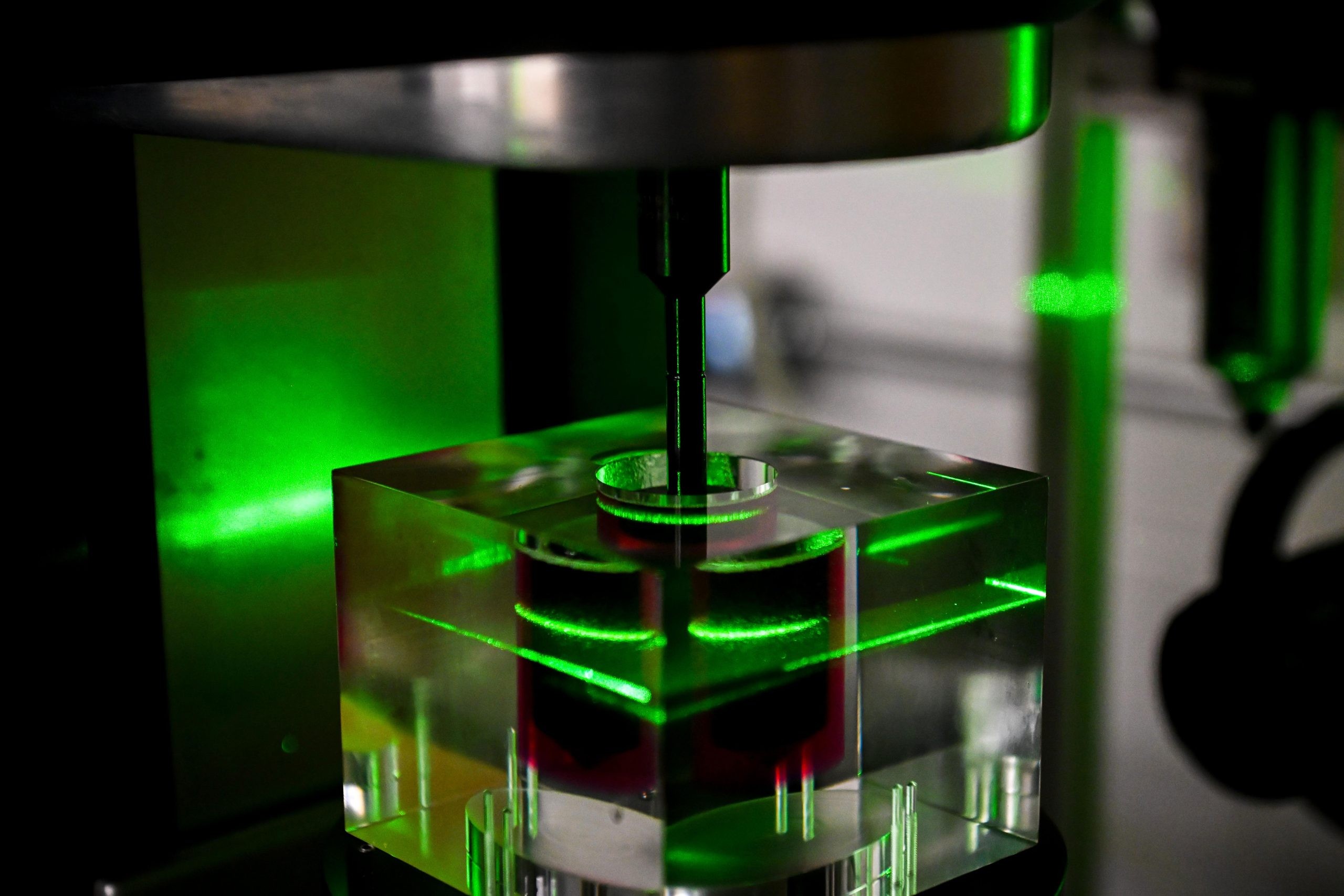
The study focuses on non-Brownian suspensions. Think of chocolate syrup or wet concrete. Large particles float in a viscous liquid. They are too heavy for Brownian motion—the jittery dance driven by thermal energy. Instead, their movement is dictated by external forces. Stirring. Shaking.
Earlier work showed these mixtures retain specific data. Stirring them imprints a directional memory. Rocking them side-to-side records the amplitude, or strength, of that movement. Until now, each memory had been studied in isolation.
Surendra Padamata, the lead graduate student on the project, put it bluntly: “When you save a file on your computer that new memory does not influence any other files already there. But in neuroscience, we know that a long-term memory might change over time.”
Consider a book read in adolescence. It’s a simple story then. Read it decades later, after life has complicated your view, and the layers change. New short-term experiences rewrite the interpretation of old data.
The team wanted to see if matter behaves this way. Can a material remember both where it was pushed and how hard? And what happens when those memories conflict?
Erasing the Past
The answer lies in intensity.
In experiments published in Physical Review Letters —and selected as an editor’s suggestion—the researchers first stirred the suspension. This locked in a directional record. Then, they rocked the mixture at varying intensities.
Gentle rocking allowed both memories to survive. The suspension remembered the initial stir and the gentle oscillation.
But cranked up the heat? Literally, the motion.
As the rocking strengthened, the directional memory began to fade. It didn’t just weaken. It vanished. At a certain threshold, the new motion completely erased the previous path, returning the suspension to a perfectly symmetric, blank state.
“Beyond that threshold, the rocking itself begins to写 a new directional memory,” Padamata noted. The old record was gone. The new one took over.
Why Competition Happens
Why does one memory delete the other? The team proposes a simple mechanical reason: frequency of contact.
During weak rocking, particles don’t bump into each other often enough to disrupt the existing structure. Both memories persist.
But strong rocking forces frequent, violent encounters. The particles scramble the configuration too quickly for the older directional history to hold. The system resets.
This limit on memory capacity might be universal. It appears not just in liquids. Nathan Keim, associate professor and team leader, points out that similar directional and amplitude memories show up in soft glasses and granular packs. These materials have vastly different microscopic physics. Yet, they share this constraint.
Disordered matter seems to have a limited filing cabinet. It can’t sort infinite competing inputs.
Beyond the Lab Bench
The implications stretch far beyond physics journals.
Keim suggests these findings could model biological memory. Or perhaps geophysics. Imagine rock strata that retain “memories” of past temperature shifts or vibrations. Could these internal marks predict earthquake risks? Sinkhole collapses?
If rocks remember, we might be able to erase those dangerous memories. We might find a way to reset the strain, reducing geological risk or building better predictive models for disaster-prone areas.
The Human Frontier Science Program funded this look into the stubbornness of matter. The results are stark. Memory in matter is not a static archive. It is a battlefield.
And sometimes, the loudest voice wins.