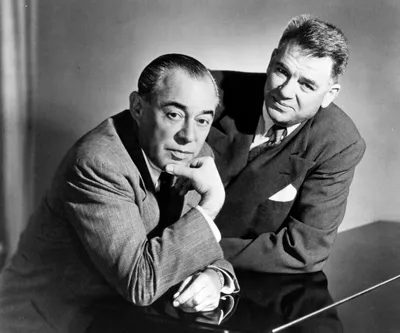
He didn’t just write songs. He built the architecture of Broadway’s golden age. Richard Rodgers (1902–1979) was a titan. A composer with more than 1,500 songs to his name. He co-wrote over 50 musicals. Some of them changed theater forever.
Think of Oklahoma! in 1943. Think of The Sound of Music in 1959. Or Pal Joey in 1940. These aren’t just shows. They are landmarks.
Rodgers is one of the few people to ever achieve EGOT status. That means he won the Emmy, Grammy, Oscar, and Tony. All four major awards. He did it before the internet existed. Before streaming. Before the modern industry took over.
Early Life and Roots
Born in Hammels Station, New York, on June 28, 1902. He was one of two sons. His parents were Russian Jewish immigrants. His father, William Rodgers (originally Rogazinsky), was a doctor. His mother, Mamie (née Levy), played piano at home. She was an amateur musician.
That home life mattered. Young Richard learned piano early. He started composing for amateur boys’ club shows. By his teens, he wasn’t just writing tunes. He was writing full musicals. He had copyrighted his work before most kids finish high school.
The Hart Partnership
Before the Hammerstein years, there was Lorenz Hart. The partnership was legendary. It defined the 1930s. Their songs were witty. Sharp. Bittersweet. They created a new kind of musical comedy. One where lyrics and music were tightly woven. Not just stand-alone hits.
Rodgers and Hart wrote together for years. They built a reputation. A style. A sound. It was distinct. It was theirs.
The collaboration with Lorenz Hart defined an era of American musical theater, blending Rodgers’ melodic genius with Hart’s lyrical wit.
But partnerships change. The war changed everything. And then came Oscar Hammerstein II.
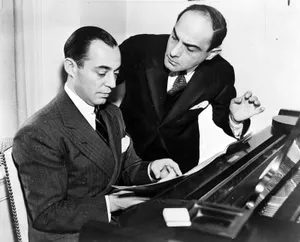

The Rodgers and Hart Era
Richard Rodgers’ partnership with Lorenz Hart began in 1919. They met through a connection to Rodgers’ brother. Hart was seven years older. He had dropped out of Columbia University. He worked translating German operas and plays. Both men admired Jerome Kern. Kern was the composer behind Show Boat. He pioneered a distinctly American musical theater style.
Rodgers enrolled at Columbia. He and Hart collaborated on the 1919 varsity show, Fly with Me. Rodgers left Columbia after a year and a half. He wanted to compose full-time for musical theater. He studied at the Institute of Musical Art in New York. This school is now known as the Juilliard School of Music. He spent two years studying composition there. During that time, he and Hart produced several amateur shows together.
Their first professional break came in 1925. The revue was called The Garrick Gaieties. It included the song “Manhattan.” Their 1936 comedy, On Your Toes, changed the landscape of the genre. It featured the jazz ballet Slaughter on Tenth Avenue. George Balanchine handled the choreography. This production introduced ballet to the musical stage. It established serious dance as a permanent fixture of musical comedy.
Other notable works followed. Babes in Arms arrived in 1937. It gave us “My Funny Valentine” and “The Lady Is a Tramp.” They also wrote I Married an Angel in 1938. That same year, they adapted Shakespeare’s The Comedy of Errors into The Boys from Syracuse.
Pal Joey in 1940 marked a shift. Adapted by John O’Hara from his own short stories, it moved away from pure escapism. It aimed for serious drama. It was too realistic for its time. Audiences didn’t respond well initially. But a 1952 revival brought enormous success. The show included “Bewitched, Bothered, and Bewildered.”
The pair also wrote for film. “Blue Moon” was released in 1934. It was their only song not introduced in a stage or film production. Their final collaboration was By Jupiter in 1942. This came one year before Hart’s death.
The Shift to Oscar Hammerstein
After Hart’s death, Rodgers needed a new lyricist. He turned to Oscar Hammerstein II. This partnership would define the Golden Age of Broadway. But the transition wasn’t instant. Rodgers had to adjust to Hammerstein’s literary approach. Hart had been the witty, cynical half of the duo. Hammerstein was the idealist.
The first major success came with Oklahoma! in 1943. It integrated song, dance, and story into a seamless whole. This was a departure from the revue-style beginnings of the Rodgers and Hart era. The success of Oklahoma! paved the way for massive hits. Carousel followed in 1945. South Pacific came in 1949. The King and I arrived in 1951.
Then came The Sound of Music in 1959. It became one of the most beloved musicals of all time. Rodgers and

The Rodgers and Hammerstein Blueprint for Broadway Dominance
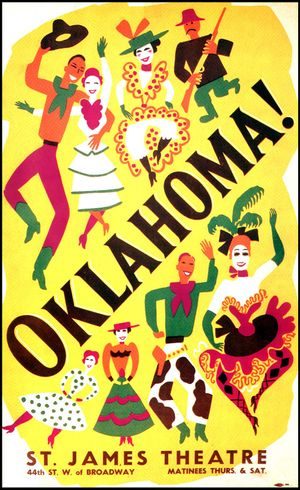
It started with Green Grow the Lilacs. In 1942, Richard Rodgers and Oscar Hammerstein II took Lynn Riggs’s play and twisted it into something entirely new. The result was Oklahoma! in 1943. It wasn’t just a hit. It broke the mold.
The show ran for 2,248 performances. That number was staggering at the time. Agnes de Mille’s choreography fused dance into the narrative in a way audiences hadn’t seen before. Songs like “Oh, What a Beautiful Morning” and “People Will Say We’re in Love” didn’t just entertain; they advanced the plot. The 1955 film adaptation captured that magic, but the stage version won the Pulitzer Prize in 1944. This partnership lasted 17 years. It only ended when Hammerstein died.
Success bred more work. Carousel followed in 1945, with a film version in 1956. It was good. Allegro in 1947 was experimental and stumbled. But then came South Pacific in 1949.
This was different. The show tackled racial prejudice head-on. It wasn’t afraid of it. The music matched the characters’ psychological depths. “Some Enchanted Evening” and “Younger than Springtime” became standards, but the real power was in the confrontation of bias. The Broadway run lasted almost as long as Oklahoma! did. Rodgers and Hammerstein won a second Pulitzer Prize in 1950. Rodgers also took home a Tony for the best original score.
Expanding the Catalogue and Hollywood Crossovers
They kept the momentum going. The King and I arrived in 1951. It was exotic, complex, and visually striking. A film version followed in 1956. Then came Pipe Dream in 1955. It didn’t resonate as strongly. The Flower Drum Song in 1958 brought a different cultural flavor to the stage, with a film version in 1961.
But the crown jewel was The Sound of Music. Premiering in 1959, it became one of their major successes. It won the Tony for Best Musical. The 1961 Grammy for Best Show Album went to the cast recording.
Rodgers wasn’t just sticking to the stage. He had already won an Academy Award for Best Original Song in 1946 for “It Might as Well Be Spring” from the film State Fair. The duo knew how to translate their theatrical weight into cinema.
Final Years and a Lasting Legacy
Hammerstein’s death in 1960 left Rodgers alone. He didn’t stop. He kept writing. The documentary Victory at Sea in 1952 showcased his ability to score epic historical narratives. He also composed for Winston Churchill: The Valiant Years (1961–63). That work earned him an Emmy in 1962.
The blockbuster Sound of Music film in 1965, starring Julie Andrews, required one last addition. Rodgers wrote “I Have Confidence” specifically for the screen.
His final theater work, No Strings in 1962, was risky. The orchestra was placed on stage. Audiences could see the musicians. It was a bold statement about the visibility of the creative process. Rodgers won a special Tony for this innovation. The citation also acknowledged his contributions to young people in the theatre. He took home a Tony for Best Score and a Grammy for the album.
Recognition accumulated in the decades that followed. He entered the Songwriters Hall of Fame in 1970. The Kennedy Center honored him in 1978. He published his autobiography, Musical Stages, in 1975.
Health issues mounted. Cancer. A heart attack. The body gave out before the memory of his work faded. Rodgers died in 1979 at age 77. It was months after I Remember Mama debuted.
The institutional memory of his work only grew stronger. In 2003, the Library of Congress added the original 1943 cast recording of Oklahoma! to the National Recording Registry. They deemed it culturally, historically, and aesthetically significant.
The songs remain. The stagecraft remains. The partnerships that defined American musical theater are now part of the permanent record.