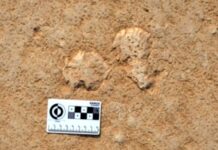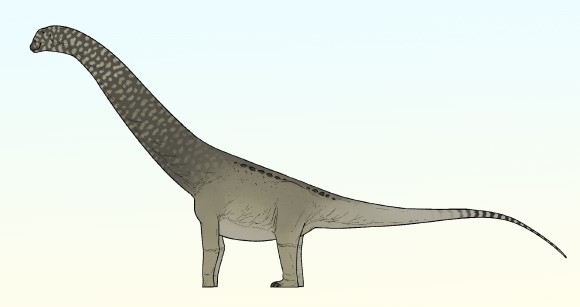
A team of paleontologists, led by Dr. Nick Longrich of the University of Bath, has identified a new species of titanosaurian sauropod that challenges our understanding of dinosaur distribution. The newly named Phosphatotitan khouribgaensis was discovered in Morocco, but its biological blueprint points toward a surprising connection to the massive dinosaurs of South America.
A Bridge Between Continents
The discovery of Phosphatotitan is significant because of its evolutionary lineage. While found in North Africa, the specimen shows close morphological ties to Lognkosauria, a group of titanosaurs previously thought to be primarily resident in South America. This group includes some of the largest land animals to ever walk the Earth.
The anatomical similarities—specifically the short vertebrae, expanded neural spines, and a broad pubis—suggest two possible prehistoric scenarios:
1. Ancient Connectivity: These dinosaurs may have inhabited the supercontinent Gondwana before Africa and South America drifted apart.
2. Oceanic Crossing: The species may have successfully crossed narrow ocean barriers that existed between the continents during the Late Cretaceous.
The “Island Effect” in North Africa
Despite its connection to South American giants like Patagotitan, Phosphatotitan khouribgaensis was not a colossus. Researchers estimate the species weighed only 3.5 to 4 tons, making it relatively modest compared to its massive relatives.
This difference in scale provides a clue about the ancient environment of Morocco. The fossils were recovered from the Oulad Abdoun Basin, which was once a warm, shallow sea. Scientists believe that high sea levels during the Late Cretaceous (approximately 70 million years ago) may have turned parts of North Africa into a series of isolated islands.
“High sea levels in the Late Cretaceous may have created isolated landmasses, with distinct faunas emerging that reflect a combination of vicariance, endemism, and regional extinction.”
In biology, this is known as endemism : when a species evolves in isolation, developing unique traits distinct from its ancestors. The smaller size of Phosphatotitan likely reflects these environmental pressures, as isolated island ecosystems often support smaller-bodied species than mainland environments.
Filling the Knowledge Gap
For much of paleontological history, our understanding of dinosaur diversity has been heavily skewed toward Laurasia (the northern hemisphere, including North America and Europe). The southern hemisphere, particularly Africa, remains much less understood.
The discovery of Phosphatotitan suggests that the Late Cretaceous of Africa was home to a unique, localized ecosystem. This finding implies that dinosaur diversity was much more complex and fragmented than previously thought, complicating our ability to map global patterns of extinction and evolution.
Conclusion
The discovery of Phosphatotitan khouribgaensis reveals that Late Cretaceous Morocco was a unique evolutionary hub, hosting specialized species that linked African ecosystems to South American lineages through shared ancestry or migration.