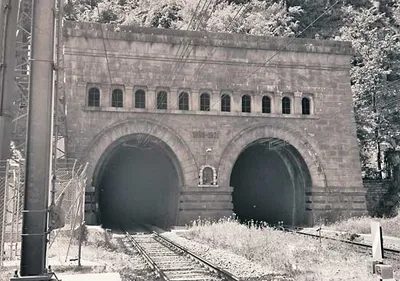
The Simplon Tunnel connects Iselle, Italy, to Brig, Switzerland, cutting through one of Europe’s most formidable mountain barriers. At 20 kilometers (12.5 miles) long, it remains one of the longest railway tunnels in the world. When it first opened in 1906, it was the largest Alpine tunnel ever built. It wasn’t just a shortcut. It was a massive engineering gamble that redefined what was possible underground.
Why the Simplon Tunnel was so hard to build
The Simplon Pass had been a trade route between northern and southern Europe since the 13th century. Napoleon I improved the surface road in the early 19th century, but a railway needed something more direct. Engineers started digging in the 1890s under the leadership of Alfred Brandt, head of the German firm Brandt, Brandau & Company. Brandt was also the inventor of an efficient rock drill.
The main problem was depth. The tunnel burrows more than 1.6 kilometers (1 mile) beneath Monte Leone. That depth created extreme heat and water pressure. Temperatures exceeded 49 °C (120 °F). Water inrushes hit as high as 49,270 liters (13,000 gallons) per minute. Surveying instruments even failed because the gravitational pull of the surrounding mountains deflected their readings.
How Brandt split the tunnel to survive the heat
Standard techniques failed. So Brandt did something radical. He divided the tunnel into two separate parallel galleries, 17 meters (55 feet) apart. This allowed two pilot headings to be driven simultaneously. Cross-cuts connected them, providing ventilation and a circuit for work trains. It was a clever way to manage air flow and logistics in a space where the rock was pushing back.
Water and fault zones still caused chaos. In one stretch of fault rock riddled with springs, conventional timbering collapsed. The crews had to line the pilot heading with 74 steel frames, each 50 cm (20 inches) thick. It was a brute-force solution to a hydraulic nightmare.
Which delays stopped the Simplon Tunnel from finishing on time
Alfred Brandt died long before the first gallery was completed. The first tunnel broke through in January 1905, and traffic began in 1906. The second gallery faced different obstacles. World War I broke out, and resources were diverted. Construction stalled. The second gallery finally opened to traffic in 1922.
The delay wasn’t just about money. It was about war, labor shortages, and the sheer scale of the project. Yet the tunnel held. It stands as a testament to how engineering adapts when nature fights back.
“The greatest engineering feats are not always about strength, but about persistence.”
Today, the Simplon Tunnel is a critical rail link between Italy and Switzerland. It handles heavy freight and passenger traffic daily. The heat, the water, the steel frames, the parallel headings. All of it happened because someone refused to let the mountain win.