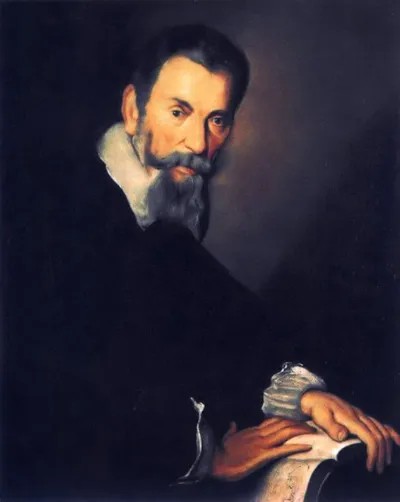
Born in Cremona in 1567 and dying in Venice in 1643, Claudio Monteverdi wasn’t just a composer. He was the architect of a new sound. He took the late Renaissance musical landscape and carved out space for the opera. He also dragged church music into the modern era, infusing it with a secular pulse that had never been heard before.
His start was humble. His father was a barber-surgeon and chemist. But the boy had ears for music. He studied under Marcantonio Ingegneri, the director of music at Cremona cathedral. Ingegneri was no slouch. He wrote respected church music and madrigals that were current for the 1570s, even if they weren’t revolutionary.
Monteverdi picked it all up fast. Too fast, maybe. By his teens, he was publishing books of religious and secular music. They were competent. They sounded like his teacher. But they were his.
The real shift happened in Venice. Two books of madrigals dropped in 1587 and 1590. These were printed by one of the city’s most famous houses. The music was better. Sharper. More modern than Ingegneri’s stuff. He was likely studying Luca Marenzio. Marenzio was the king of Italian madrigals at the time. Everyone wanted to sound like him.
So did Monteverdi. But there was a difference in intent. Early Monteverdi wanted to charm you. He didn’t yet want to rip your heart out. His goal was elegance. Pleasure. You can hear it in his setting of Torquato Tasso’s “Behold the Murmuring Sea.” It’s attractive. It’s skilled. But it’s polite.
He wasn’t there yet. The passion was coming. The storm was brewing. But in those early Venetian years, he was just a very talented kid with a printer’s press and a lot of ambition.
The Mantua years
Monteverdi likely left his hometown around 1590, stepping into the employ of the Duke of Mantua as a string player. It was there, in that court, that he collided with the era’s most formidable talent. The composer who reshaped his trajectory was Giaches de Wert. A Flemish modernist working in the avant-garde current of the 1590s, Wert operated on a single principle: music had to mirror the exact mood of the text. Natural declamation was non-negotiable.
Wert chose poetry from Tasso and Battista Guarini. The result was highly emotional, if not particularly melodic. It was difficult to sing. It had an immediate, corrosive effect on Monteverdi. His first book of madrigals, published in that initial year at Mantua, showed the influence, though he hadn’t quite mastered it yet. It was a complete pivot. The melody became angular. The harmony grew increasingly dissonant. The mood turned tense, bordering on neurotic. Guarini was the favorite poet. Every nuance of the verse was expressed, even if it broke musical balance.
Struggles and Stagnation
This new style seemed to jam his creative gears. He kept composing but published almost nothing for the next eleven years. In 1595, he tagged along on a military expedition to Hungary. Four years later, another trip to Flanders. Around 1599, he married Claudia Cattaneo, a singer. They had three children; one died in infancy.
When Wert died in 1596, the post of maestro di cappella opened up. Monteverdi was passed over. He was bitter. He didn’t secure the directorship until 1602, at age 35.
Then, the floodgates opened. He published two books of madrigals in 1603 and 1605. Both contained masterpieces. The avant-garde manner was now fully assimilated. He still chased the meaning of the verse, but he solved the musical problems of thematic development and proportion. The dissonances got harsher. The melody remained jagged. But the overall effect was more varied, less neurotic. Where Guarini’s eroticism triggered a sensual style, Monteverdi often injected his mature madrigals with lightness and humor. He saw the essence of the poem, not just the details.
The Theory Wars
His advanced techniques—specifically the intense, prolonged dissonance—angered the conservatives. Monteverdi became the figurehead for the avant-garde. A Bolognese theorist named Giovanni Maria Artusi attacked him in a series of pamphlets. This controversy made Monteverdi the most famous composer of his age. It forced him to respond with a major aesthetic statement.
He denied being a revolutionary. He claimed to be following a tradition developing for fifty years. This tradition sought a union of the arts, specifically words and music. He argued he shouldn’t be judged on conventional musical devices alone. The artwork had to be powerful enough to “move the whole man.” That might mean abandoning certain conventions.
But he also declared faith in an older tradition. One where music itself was supreme. Pure polyphony, like that of Josquin des Prez and Giovanni Palestrina. He called these two “practices.” It was an immensely influential view. It established a dichotomy that would last into the 19th century: the old style for church music, the modern style for opera and cantatas.
Orfeo and the Birth of Opera
Madrigals had given him a reputation outside northern Italy. But it was his first opera, Orfeo (1607), that cemented him as a master of large-scale music, not just exquisite miniatures. He likely saw early performances by Florentines like Jacopo Peri and Giulio Caccini. He had written stage music before, but Orfeo showed a broader conception of the genre.
He combined the opulence of late Renaissance dramatic entertainments with the straightforwardness of a simple pastoral tale in recitative. The Florentine ideal was heightened speech. Monteverdi’s recitative was more flexible, more expressive. It was based on the declamatory melody of his madrigals. Above all, he possessed a gift for dramatic unity. He shaped whole acts into musical units instead of assembling them from small sections. He matched dramatic climaxes with musical ones, using dissonance, virtuosity, or instrumental color to create heightened emotion.
Did he invent opera? No. But he proved it could hold an audience. The rest is history. Or so they tell you.
The Cost of L’Arianna and the Music of Grief
The personal toll of Orfeo ’s production was steep. Monteverdi lost his wife to a long illness shortly after the premiere. Grief-stricken, he retreated to his father’s home in Cremona. But Mantua didn’t wait. The Gonzaga court needed music for the marriage of heir Francesco Gonzaga to Margaret of Savoy. They summoned him back. Reluctantly, Monteverdi returned. The workload was crushing. He wasn’t just writing an opera; he was scoring a ballet and intermezzi for a play.
Then came a second tragedy. During rehearsals for the new opera, L’Arianna, the prima donna died of smallpox. This young woman had lived in Monteverdi’s house, possibly as a student of his late wife. The production stalled. The role was recast. By May 1608, the opera finally opened. It was a massive hit. Unfortunately, the full score is lost to time. Only the “Lamento” survives, in various iterations. It stands as the first great operatic scena —a scene of intense dramatic power, usually anchored by arias.
Burnout and Bitterness
The success of L’Arianna broke him. Monteverdi collapsed back into his Cremona sanctuary. This period of exhaustion lasted a long time. When the court ordered him back in November 1608, he refused. Eventually, he went. But the relationship with the Gonzaga family soured permanently. He believed they undervalued and underpaid him. Sure, he got a raise and a small pension after L’Arianna. That didn’t fix the resentment.
His creativity didn’t vanish, but it turned dark. The music from this era reflects his depression. He arranged the “Lamento” as a five-voice madrigal. He also composed a threnody—a mourning song—on the death of his singer. The sestina, published later in his sixth book of madrigals, represents the peak of dissonant, agonized writing in that style.
Vespro della Beata Vergine : A Theological Statement
Amid the gloom, he wrote some church music. Published in 1610, the volume included a mass in the old style and music for Vespers on feasts of the Blessed Virgin Mary. The mass was a bold statement. Monteverdi wanted to prove that complex polyphony wasn’t dead, even as newer trends swept the continent.
The Vespers music is even more remarkable. It serves as a virtual compendium of modern sacred music. You get grand psalm settings in the Venetian manner. Virtuoso parts for soloists. Instrumental interludes. He even tried to use contemporary operatic techniques to set the emotional words of the Magnificat.
Yet, for all its modernity, the work extends an ancient tradition. Monteverdi used plainsong tunes—unaccompanied liturgical chants—as the thematic core for the psalms and Magnificat. It was music of the Counter-Reformation. It blended traditional and new, secular and religious tools. The goal was clear: to impress the listener with the power of the Roman Catholic Church and its God.
The sheer ambition of that 1610 volume suggests a man fighting to define his legacy. He wasn’t just composing notes; he was building a wall against obsolescence. But the money troubles and the court politics lingered. Did the artistic triumph silence the personal grief? Probably not. The music just got louder to drown it out.
The Maestro di Cappella role and Venetian influence
When the maestro di cappella of St. Mark’s Basilica passed away, Monteverdi didn’t just get a nod; he was invited to audition. He secured the post in the autumn of 1613.
Why him? The musical establishment had been sliding into irrelevance. Giovanni Gabrieli, the last significant native Venetian composer, had recently died. The place needed experience. Monteverdi wasn’t primarily a church musician by training, but he treated the job with brutal seriousness. Within a few years, he had completely revitalized the basilica’s output. He brought in fresh talent, hiring assistants like Francesco Cavalli and Alessandro Grandi, who would go on to become notable composers themselves. He mandated daily choral services and wrote a mountain of sacred music. He didn’t stay in the basilica, though. He directed music for the S. Rocco fraternity, an influential philanthropic brotherhood, during their annual patron saint festivals.
The letters from this early Venetian period show a man transformed. The anxiety of Mantua was gone. He felt honored. He was paid well. He was prolific. He still kept ties to Mantua, mostly because Venice had no opera scene and the Gonzaga court offered regular work. But in his correspondence, a new philosophy emerged. It wasn’t just about filling time; it was about shaping the future of opera.
The older style of opera came from two places: the Renaissance intermezzo and the pastoral genre. Intermezzi were short, static, and often allegorical, focusing on the wishes of the gods. Pastoral works were highly artificial, full of shepherds and shepherdesses. Monteverdi wanted none of it. He wanted human emotion. He wanted recognizable people who changed their minds and moods. To do this, he needed new musical tools.
In his seventh book of madrigals (1619), he experimented. He borrowed heavily from his younger contemporaries but gave them more power. He used “musical letters”—severe recitative melodies written to match the words like a conversation. Then there was Tirsi e Clori (1616), a ballet for Mantua. It showed a complete acceptance of the simple tunefulness of the modern aria.
Stylistic evolution and personal crises
This push for a practical music philosophy continued through the 1620s. He absorbed ideas from Plato, dividing emotions into three buckets: love, war, and calm. Each required different rhythms and harmonies. He also embraced realism. He wanted to imitate the sounds of nature.
You can hear this in The Combat of Tancredi and Clorinda (1624). It’s a dramatic cantata set to a section of Tasso’s Gerusalemme liberata. The piece features rapid reiteration of single notes in strict rhythms. It uses pizzicato—plucking the strings—to mimic the clash of swords. This was a major step forward for idiomatic string writing.
The trend continued with Licoris Who Feigned Madness, a comic opera likely intended for Duke Vincenzo II of Mantua’s accession in 1627. The score is lost, but the correspondence survives. This was a stressful time. His elder son, Massimiliano, was a medical student in Bologna. He had read books banned by the Inquisition and was imprisoned. It took months for Monteverdi to clear the charge. The same year, Monteverdi fulfilled a commission for intermezzi to Tasso’s L’Aminta and a tournament in Parma, celebrating Duke Odoardo Farnese’s marriage to Margherita de’ Medici.
The plague, holy orders, and a retrospective
The plague hit Venice in 1630. Monteverdi and his family survived. He took holy orders during the epidemic. When the plague was officially declared over in November 1631, he wrote a grand mass for the thanksgiving service at St. Mark’s.
The “Gloria” from that mass survives. It shows him applying his theories on mood diversity. But the music is calm. Majestic. It lacks the passion of his earlier years. Some church music from this time reflects the same tone. A book of lighthearted songs and duets published the following year is much the same.
There is a detached quality to much of the music in his final madrigal collection, assembled in 1638. It’s a vast retrospective anthology dating back to 1608. The title, Madrigals of War and Love, explicitly lays out his theories. It’s a summary. A closing statement. But the music doesn’t quite close the door. It just fades out.
Venice’s Opera Boom and Monteverdi’s Late Masterpieces
Monteverdi was already pushing 70 when this final chapter of his career began. You might think that age signals a quiet exit from the stage. It didn’t. Instead, a cultural shift in Venice gave the old master a second wind. In 1637, the city opened its first public opera houses. This was a game-changer. Suddenly, opera wasn’t just a courtly luxury for the elite. It was for the public.
As one of the few composers with serious experience in the genre, Monteverdi was practically handed the keys. He didn’t just watch from the sidelines. He dove in. L’Arianna got a revival. More importantly, he wrote four new operas in roughly three years. It was an astonishing burst of productivity for someone his age.
The Two Surviving Masterpieces
Time is cruel. Only two of those late works have survived in full score. But oh, what works they are. The Return of Ulysses to His Country (Il ritorno d’Ulisse in patria ) and The Coronation of Poppea (L’incoronazione di Poppea ) are not just good. They are masterpieces.
Scholars often point out that these operas still carry traces of the Renaissance intermezzo and pastoral traditions. Don’t let that fool you. They can fairly be described as the first modern operas. Why? Because they focus on realistic human situations. The plots are complex. You have main storylines tangled with subplots. The cast is a mix of nobility, servants, the wicked, the misguided, and the innocent. It’s a full spectrum of humanity.
The music mirrors this realism. It captures emotions with startling accuracy. Monteverdi took the philosophy he developed during his early Venice years and put it to work. He used every tool available to a composer of the time. That meant the fashionable arietta (short arias), duets, and ensembles. He combined these with the less trendy but highly expressive recitative from the early 17th century.
Drama First, Music Second
The emphasis in these scores is always on the drama. The musical units are rarely self-contained. They are woven into a continuous pattern. The music serves the story. It remains a means to an end, not the end itself. There is a sense of building toward a grand climax. This inspires expansive scena moments for the lead singers—whether it’s Ulisse, Nero, or Poppea.
Yet, the operas are musically attractive. They offer enough memorable melodies to stick in your head. This balance is what makes them endure.
A Composer’s Final Honors
With these works, Monteverdi cemented his status as one of the greatest musical dramatists in history. His Venetian employers knew it. They showed their respect by giving him money during his last years. They also granted him leave to travel to his native city in the final months of his life.
The public’s respect was even more visible. After a short illness claimed him, the people of Venice came to his funeral. He was buried in the Church of the Frari. A monument to him stands there still. It’s a quiet tribute from the city that gave his late career its spark.