You know the ones. Those long, stiff hairs twitching above the eyes or flanking the nose. We stare at a cat’s face. We notice the whiskers.
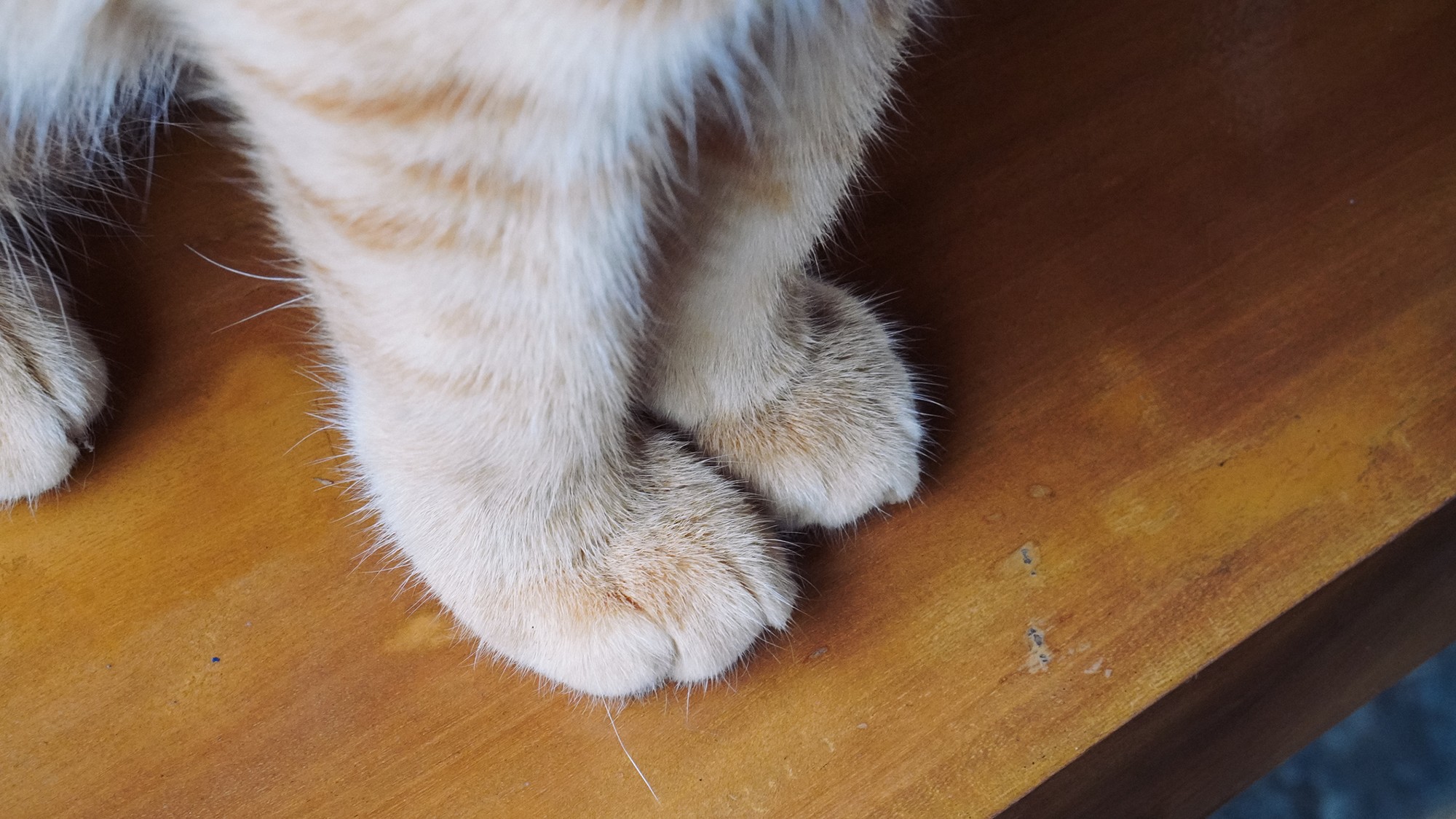
But look closer. At the back of the front leg. Right above the “wrist.”
There is another tuft there. Four to six whiskers, about an inch long. They don’t blink when a bug flies near them like the eyebrow hairs. They don’t help with depth perception like the cheek whiskers.
So why do cats have leg whiskers at all?
The answer isn’t in the whisker itself. It’s in the nerve ending buried deep in the skin below.
It’s not actually the wrist
First, a correction on anatomy. Those whiskers sit on the carpal vibrissae.
The name refers to the carpal bones. In humans, those bones form the wrist. In cats? Not so much. Cats walk on their toes. Their “wrist” is higher up the leg than ours. It’s more like an ankle that forgot its place.
The carpal whiskers sit right over those bones. Each one is rooted in a follicle packed with nerve endings. These are mechanoreceptors. They detect the slightest movement of air. Or contact.
“Carpal whiskers are attached to the forelegs near the carpal bones… cats essentially walk on their toes,” says evolutionary biologist Jonathan Losos.
They are stiff. Thick. Several times heavier than fur. They are biological radar.
Why did evolution keep them?
Not every animal has them. Dogs? No. Horses? Nope. Rabbits don’t either.
Cats do. And so do most carnivores. Some rodents. Lemurs. Even armadillos.
There’s a pattern here. Animals with carpal vibrissae tend to do two things:
* Climb trees.
* Grasp things with their front paws.
Dogs can’t do that. They don’t have the wrist flexibility to turn their paws sideways or bring their palms together to pinch or grab. Cats can.
“The idea is that if it’s hard to see what you’re grasping, carpal whiskers supplement vision,” Losos explains. “Cats move their forearms laterally… dogs can’t.”
It’s a tactile backup system. When a cat is stalking prey in low light, its vision fails. Cats can’t focus on anything closer than 10 inches. Their eyes are built for distance. The whiskers handle the near field.
The face whiskers tell the cat where the mouse is.
The leg whiskers tell the cat how to land. Or how to hold it.
What do they actually do?
We don’t know everything. Science still debates the exact role. But sensory biologist Robyn Grant has a theory.
“They likely guide locomotion… safe forepaw placement, especially during complex movement like climbing,” Grant says.
Imagine a cat leaping onto a fence. Or stalking through tall grass. The visual field is cluttered. Shadows lie. Debris hides.
When that front paw swings forward, the carpal whiskers brush against branches. They feel the wind displacement. They hit a twig.
The brain gets a signal before the paw even touches the obstacle. It adjusts the trajectory. Micro-second corrections.
It might also help with prey handling. If a cat catches something slippery. Something small. The whiskers on the leg could help gauge size and texture as the paw closes in.
Dogs don’t need this. They bite and hold. They shake and tear. Cats often bat. They catch with their paws. They need to know exactly what their hands are touching.
Don’t pluck them.
It seems obvious. But people sometimes mistake these leg hairs for dead ends. They think they’re decorative.
They aren’t.
Each whisker connects directly to the nervous system. Pulling them is like plucking a nerve. It causes pain. Disorientation.
If your cat seems clumsy. If they’re hesitating before a jump. If they’re knocking things over.
Check the whiskers. Not just on the face. On the legs too.
The world is smaller than you think for a cat. And they feel every inch of it.
How much of a cat fan are you really? You can test that elsewhere. But for now, watch the next time your cat climbs. Watch the front paw. Feel the air.